- Empty cart.
- Continue Shopping

How to Keep Your Crochet Edges Straight and Even
If you have ever spent hours crocheting a blanket, scarf, bag, or other project only to notice that the sides look crooked, you are not alone. Uneven crochet edges are one of the most common problems beginners face. Fortunately, you can usually fix the problem without starting your entire project again.
So, why are my crochet edges uneven? In most cases, the problem comes from accidentally adding or skipping stitches at the beginning or end of a row. However, inconsistent tension, turning chains, and difficulty identifying the first or last stitch can also affect the shape of your project.
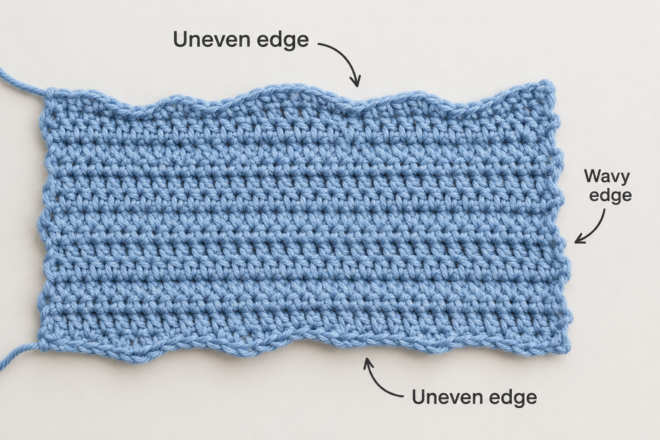
The good news is that a few simple habits can help you create straighter, cleaner rows. Once you understand where the extra or missing stitches come from, you can make it much easier to keep your project the same width from beginning to end.
Why Are My Crochet Edges Uneven?
Crochet edges usually become uneven when the number of stitches changes from one row to another. For example, if your pattern requires 30 stitches but you accidentally make 29 stitches in one row, the project can become slightly narrower.
On the other hand, adding an extra stitch can make the project gradually wider. As a result, even a single missed or added stitch can become noticeable after several rows.
Let’s look at some of the most common reasons behind uneven crochet edges.
1. Missing the First or Last Stitch
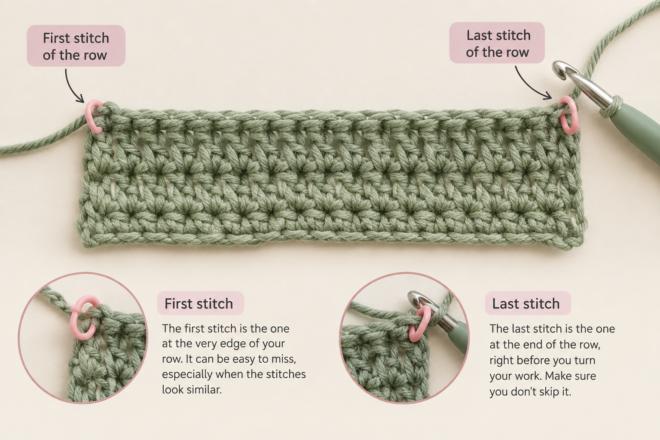
One of the biggest causes of uneven edges is skipping the first or last stitch of a row.
These stitches can sometimes look difficult to identify, especially when you are working with textured yarn or tight stitches. Because of this, beginners often insert their hook into the wrong space or simply miss the stitch altogether.
If you repeatedly skip the first or last stitch, your project can slowly become narrower.
Tip: Before starting a new row, take a moment to identify exactly where your first and last stitches should go.
2. Adding an Extra Stitch
Skipping stitches isn’t the only problem. Similarly, accidentally working an extra stitch at the beginning or end of a row can make your project wider.
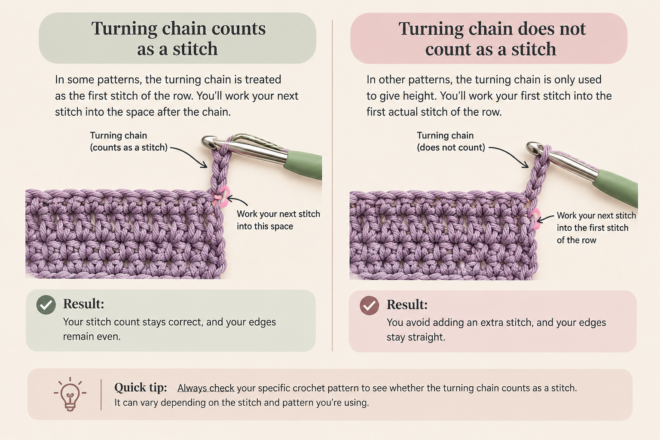
This often happens when crocheters are unsure whether the turning chain counts as a stitch. For this reason, always check the instructions in your specific crochet pattern.
Some patterns treat the turning chain as a stitch, while others do not. Therefore, the correct place to insert your hook can vary depending on the pattern and stitch you are making.
When you understand how your pattern treats the turning chain, you can avoid many accidental increases.
3. Confusing the Turning Chain
The turning chain gives you the height needed to begin the next row. However, whether it counts as a stitch depends on the pattern and the type of crochet stitch.
For example, a pattern may tell you to chain a certain number and then work into the first stitch. In another pattern, the turning chain may count as the first stitch of the row.
If you treat a non-counting chain as a stitch, or stitch into a chain that already counts as one, your stitch count can change.
Therefore, always read the pattern instructions carefully before deciding where to make your first stitch.
4. Inconsistent Yarn Tension
Your stitch count might be correct, but your edges can still look uneven if your tension changes significantly.
Yarn tension refers to how tightly or loosely you hold the yarn while crocheting. For instance, you might crochet tightly when you first start and then loosen your grip after working for a while.
As your tension changes, your stitches can become larger or smaller. Consequently, different rows may not have exactly the same appearance.
Try to maintain a relaxed and consistent grip on your yarn. Most importantly, don’t hold the yarn extremely tightly just to make every stitch look perfect.
With practice, your hands will naturally develop more consistent tension.
How to Get Straight Crochet Edges
Now that you know the common causes, let’s look at some practical ways to create straighter rows.
1. Count Your Stitches
Counting your stitches might feel tedious, but it is one of the simplest ways to catch mistakes early.
If your pattern requires 30 stitches, count your stitches at the end of each row. If you find 29 or 31 stitches, you can correct the mistake before continuing too far.
You don’t necessarily need to count every stitch forever. However, counting regularly while learning can help you understand where your first and last stitches belong.
2. Use Stitch Markers
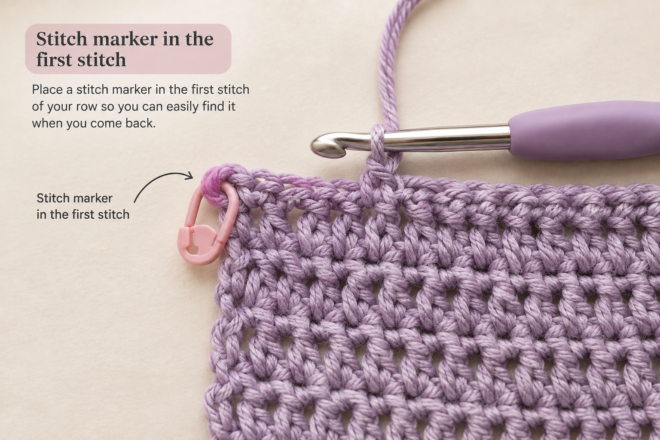
Stitch markers can make it much easier to identify important stitches, especially at the beginning and end of a row.
For example, you can place a marker in the first or last stitch so you know exactly where to work when you return to that point. As a result, you don’t have to rely entirely on identifying a small, crowded loop.
This technique becomes especially useful when working with dark yarn, textured stitches, or complicated patterns.
If you are building your crochet supplies, a set of stitch markers can become a useful addition to your toolkit.
3. Mark the First Stitch
If you regularly lose track of the first stitch, place a marker directly into it after completing the row.
Then, when you reach the end of the next row, you can easily identify where your final stitch belongs.
This simple habit can prevent many accidental decreases and increases.
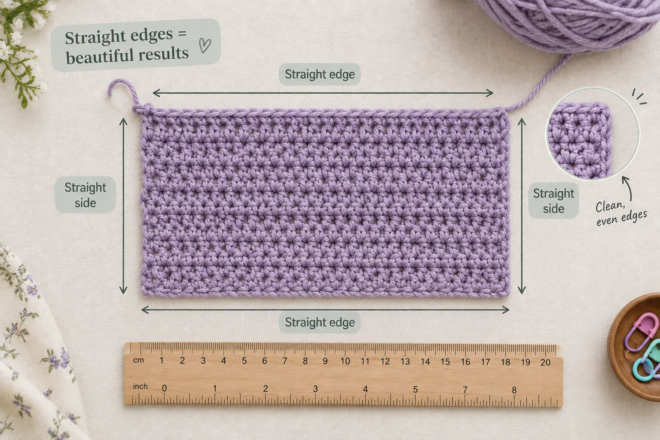
4. Check Your Edges Every Few Rows
Don’t wait until you finish your entire project to check its shape.
Instead, place your project on a flat surface every few rows and look at the edges. If one side starts moving inward or outward, you can investigate the problem immediately.
That way, you can fix a small mistake before it affects a large section of your project.
5. Use the Correct Crochet Hook
Your crochet hook can also affect the appearance of your stitches.
A hook that is too small for your yarn may create very tight stitches, while a larger hook can create looser stitches. Therefore, always check the recommended hook size on your yarn label or crochet pattern.
Your personal tension also matters. If necessary, try a slightly different hook size and make a small test swatch before starting your main project.
For beginners who work with different yarns and patterns, having multiple hook sizes can make this process easier.
What If My Crochet Edges Are Already Uneven?
Don’t panic if you have already completed several rows and notice that your project looks crooked.
First, count the stitches in a few rows to see whether your stitch count changes. If the numbers differ, you may have accidentally added or skipped stitches.
If the mistake happened only a few rows back, you can usually undo the stitches until you reach the problem and then crochet the section again.
On the other hand, if the difference is very small and the project does not require precise measurements, you may decide to leave it as it is. Handmade projects don’t always need to look perfectly machine-made.
How to Keep Crochet Rows Straight While Learning
Straight edges become easier with practice. At first, you may need to stop frequently to count stitches and identify the first and last stitch.
Over time, you’ll start recognizing the shape of your stitches more easily. As a result, you will spend less time checking each row and more time enjoying your project.
A simple routine can help:
- Check your stitch count at the end of each row.
- Identify the first and last stitch before starting.
- Use stitch markers when you’re unsure.
- Keep your yarn tension relaxed and consistent.
- Check your project every few rows.
- Follow the turning-chain instructions in your pattern.
- Make a gauge swatch when the project requires specific measurements.
Frequently Asked Questions
Why are my crochet edges uneven even when I have the right stitch count?
Even with the correct stitch count, differences in yarn tension can affect the appearance of your edges. Also, some stitch patterns naturally create more texture or movement than others.
Why does my crochet project get narrower?
Your project may become narrower when you repeatedly skip stitches. In particular, missing the first or last stitch can gradually reduce the width of your rows.
Why does my crochet project get wider?
Adding extra stitches can cause your project to become wider. This often happens when you accidentally work into a turning chain or make an additional stitch near the edge.
Should I count crochet stitches after every row?
If you are a beginner, counting your stitches after each row can help you catch mistakes early. Once you become more comfortable, you may not need to count every row, especially for simple projects.
Do stitch markers help with uneven crochet edges?
Yes. Stitch markers can help you identify important stitches and row positions. Therefore, they are particularly useful when you have difficulty finding the first or last stitch.
Final Thoughts
Uneven crochet edges can feel frustrating, especially when you are putting a lot of time into a project. However, you can usually improve your edges by paying closer attention to stitch counts, turning chains, and yarn tension.
If you keep asking yourself, “Why are my crochet edges uneven?”, start by checking the first and last stitches of your rows. Then, use stitch markers and count your stitches regularly until you become more confident.
Most importantly, give yourself time to practice. With consistent practice, your stitches will become more even, your edges will look straighter, and you’ll feel much more comfortable tackling larger crochet projects.