- Empty cart.
- Continue Shopping

How to Read Crochet Patterns as a Beginner
Crochet patterns can look confusing when you first start. You may see abbreviations, numbers, symbols, brackets, and instructions that seem difficult to understand. However, once you learn what each part means, reading a crochet pattern becomes much easier. If you’re wondering how to read crochet patterns, this beginner-friendly guide will walk you through the basics. From understanding abbreviations and stitch counts to following repeats and working through different rows, you’ll learn how to approach a pattern with more confidence.
What Is a Crochet Pattern?
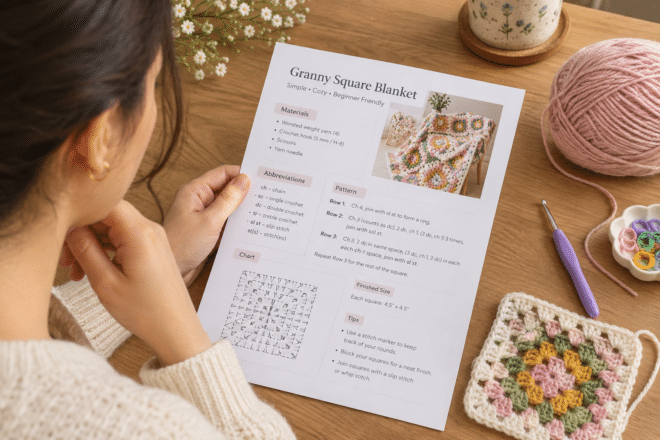
A crochet pattern is a set of written or visual instructions that tells you how to create a crochet project. It explains which stitches to make, how many times to repeat them, and how to build each row or round.
For example, a simple pattern might say:
Row 1: Ch 10, sc in 2nd ch from hook, sc across. (9 sts)
At first, this may look like a collection of random letters and numbers. However, each part has a specific meaning.
In this example:
- Ch means chain.
- Sc means single crochet.
- 9 sts means you should have 9 stitches at the end of the row.
Once you understand common crochet terminology, these instructions become much easier to follow.
Learn Common Crochet Abbreviations
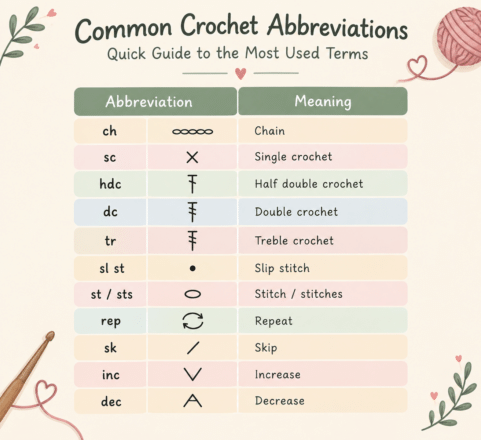
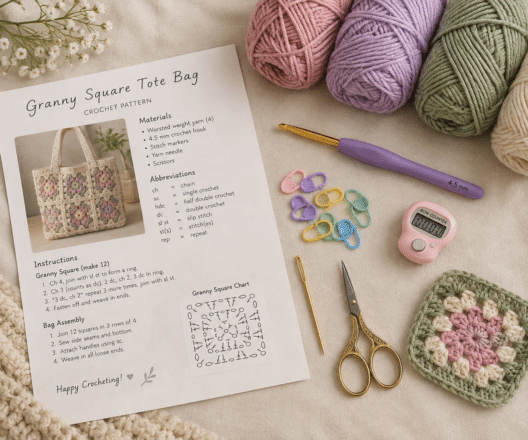
One of the first steps in learning how to read crochet patterns is understanding abbreviations. Most patterns use shortened versions of stitch names to keep the instructions concise.
Here are some common US crochet abbreviations:
| Abbreviation | Meaning |
|---|---|
| ch | Chain |
| sc | Single crochet |
| hdc | Half double crochet |
| dc | Double crochet |
| tr | Treble crochet |
| sl st | Slip stitch |
| st / sts | Stitch / stitches |
| rep | Repeat |
| sk | Skip |
| inc | Increase |
| dec | Decrease |
Tip: Always check the pattern’s abbreviation list before you begin. Crochet terminology can vary between patterns, and US and UK crochet terms are different.
Understand the Pattern Structure
Most crochet patterns follow a logical structure. They usually tell you what to do row by row or round by round.
A pattern may include:
Row 1: Ch 15, sc in 2nd ch from hook, sc across. (14 sts)
Row 2: Ch 1, turn, sc across. (14 sts)
Here, the pattern first tells you to make 15 chains. Then, you work single crochet stitches across the chain. At the end, you should have 14 stitches.
Next, you make a turning chain, turn your work, and crochet across the second row.
Therefore, it helps to read each row from beginning to end before you start crocheting it.
Pay Attention to Stitch Counts
Stitch counts are one of the most useful parts of a crochet pattern. They help you check whether you have completed a row correctly.
For example:
Row 5: Dc across. (20 sts)
This means you should have 20 stitches after completing the row.
If you count only 19 or 21 stitches, you may have accidentally skipped or added a stitch. As a result, your project could gradually become wider, narrower, or uneven.
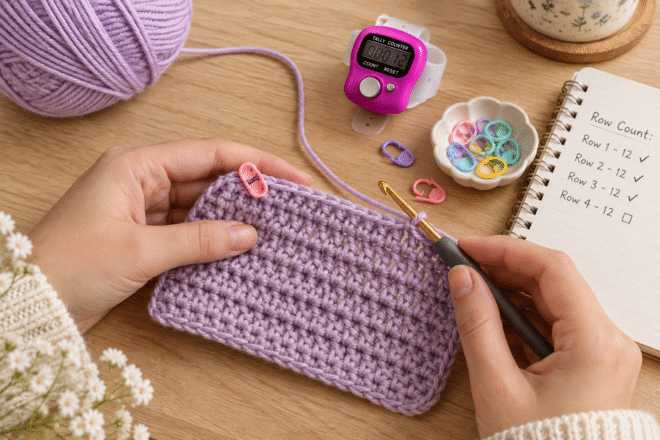
A crochet row counter can make this process easier when you’re working through a project with many rows.
Instead of trying to remember which row you’re on, you can update the counter after completing each row.
Learn How Repeats Work
Crochet patterns often use repeats to avoid writing the same instruction several times.
You may see instructions such as:
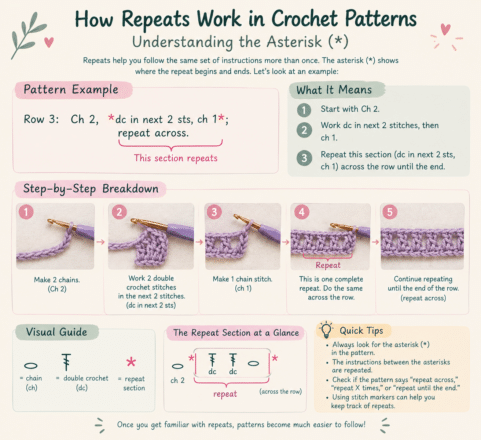
*Row 3: Ch 2, dc in next 2 sts, ch 1; repeat from * across.
The asterisk (*) tells you where the repeat begins. You then repeat the instructions until the pattern tells you to stop.
You may also see:
- ( ) for grouping stitches or instructions
- [ ] for grouped instructions or larger repeats
- * to mark the beginning of a repeat
- repeat 3 times to tell you exactly how many times to repeat an instruction
For example:
(Sc, ch 1) repeat 5 times
means you should complete the sc and ch 1 sequence five times.
Therefore, always look carefully for words such as repeat, across, around, and *from *.
Understand Turning Chains
Turning chains can sometimes confuse beginners because their purpose depends on the stitch and pattern.
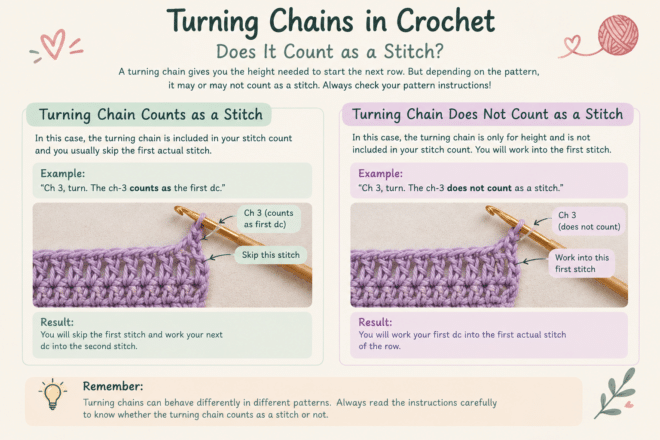
A turning chain gives you the height needed to begin the next row. However, some patterns count the turning chain as a stitch, while others do not.
For example, a pattern may say:
Ch 3, turn. The ch-3 counts as the first dc.
In this case, you should usually skip the first stitch and work into the next appropriate stitch.
Another pattern may say:
Ch 3, turn. The ch-3 does not count as a stitch.
Here, you would work your first double crochet into the first actual stitch.
Because of this difference, always check the pattern instructions before deciding where to place your first stitch.
Use Stitch Markers to Keep Your Place
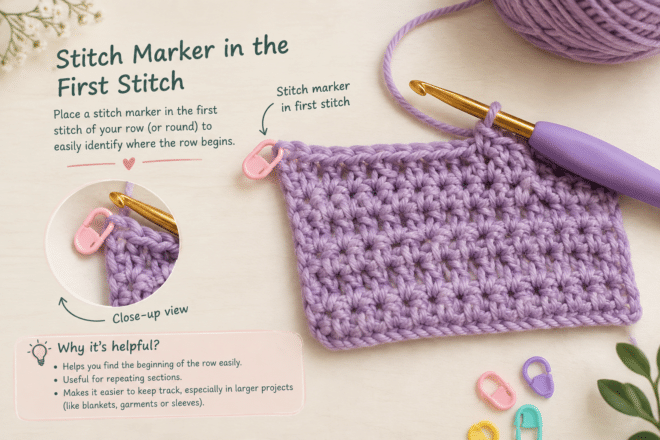
Stitch markers can be extremely helpful when you’re learning to follow crochet patterns.
You can use them to mark:
- The beginning of a round
- The first or last stitch
- A specific repeat
- Increase or decrease points
- A particular section of a complicated pattern
For example, if a pattern tells you to repeat a section several times, placing a stitch marker at the beginning can help you identify exactly where the repeat starts.
If you’re working with complicated stitch patterns, keeping a few markers nearby can make the process much easier.
Learn to Read Crochet Charts and Symbols
Some crochet patterns include charts instead of, or alongside, written instructions.
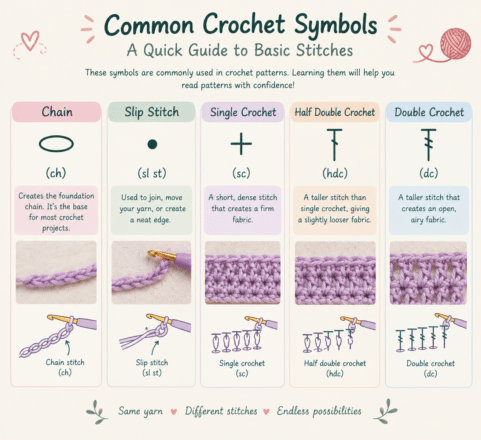
A crochet chart uses symbols to represent different stitches. For example, a chain may appear as an oval, while a double crochet may use a symbol with a vertical line and horizontal bars.
Charts can look complicated at first. However, once you learn the basic symbols, they can help you understand how stitches fit together visually. If you’re interested in learning different stitch patterns, a stitch dictionary can also help you become familiar with written instructions and crochet charts.
Understand Parentheses and Special Instructions
Patterns sometimes place instructions inside parentheses or brackets. These symbols usually group instructions together.
For example:
(2 dc, ch 1) repeat 4 times
This means you should work two double crochet stitches followed by one chain, and then repeat that entire sequence four times.
You may also see instructions such as:
2 dc in next stitch
This means you need to work two double crochet stitches into the same stitch.
Similarly, dc2tog usually means to work two double crochet stitches together as a decrease.
Therefore, don’t rush through symbols or abbreviations. Take a moment to understand what the complete instruction is asking you to do.
Check Your Pattern Before You Start
Before picking up your hook, spend a few minutes reading through the pattern.
First, check the recommended yarn and hook size. Next, look for the gauge information if the project requires a specific finished size.
Then, review the abbreviations and special instructions. Finally, look through the pattern structure so you know how many rows or rounds you’ll need to complete.
This small preparation step can save you from having to undo your work later.
Keep Track of Your Rows
When you’re working on a large project, it can be easy to lose track of where you are.
For example, you might finish a few rows, put your crochet down, and later wonder whether you completed Row 12 or Row 13.
A simple row counter can help you avoid this problem. After completing each row, update your counter before putting your project down. As a result, you can return to your project without guessing.
This is especially useful for blankets, garments, sleeves, scarves, and other projects with many repeated rows.
Start With a Simple Pattern
If you’re completely new to reading patterns, don’t start with the most complicated project you can find.
Instead, choose a simple pattern that uses familiar stitches such as chains, single crochet, or double crochet. Once you’re comfortable with those instructions, gradually move on to patterns with repeats, charts, increases, decreases, and more advanced stitches.
Most importantly, don’t worry if you need to read the same instruction several times. Pattern reading becomes easier with practice.
Final Thoughts
Learning how to read crochet patterns is an important step toward becoming a more confident crocheter. Although abbreviations, stitch counts, repeats, and charts may seem confusing at first, they become much easier once you understand how each part works.
Start by learning common abbreviations. Then, pay attention to stitch counts, turning chains, repeats, and special instructions. In addition, use tools such as stitch markers and a crochet row counter to keep your work organized.
Finally, practice with simple patterns before moving on to more advanced designs. With time and practice, you’ll be able to read crochet patterns more comfortably and turn those lines of instructions into beautiful handmade projects.